
Between boarding gates and bright stages, Darts World columnist Huw Ware exists in near-perpetual motion. As one of the Professional Darts Corporation’s globetrotting referees, his life is measured in airports and arenas. Somewhere in the gaps between continents, he also finds time to run a podcast – and
His guest was Luke Woodhouse, a man who has climbed to the highest-ranking position of his career while learning, almost belatedly, the value of stillness. A Pro Tour fixture for years, Woodhouse spoke with an unforced candour about balance, friendship, and the mental quiet that now underpins his performances.
Away from tungsten and television lights, his sanctuary is fairway and green. “I’m a massive golf fan,” he says. “I play as much as I can. For me it’s completely separate from darts.” Based at Beaulieu Pines Golf Club as a summer member, Woodhouse often plays alongside familiar faces from the circuit – PDC official Daz Rollings chief among them, with Damon Heta a regular presence too.
What matters is not the scorecard. “The great thing about golf is that it completely switches my mind off from darts,” Woodhouse explains. “I put my phone in my bag and don’t look at it for hours. You walk, you talk, you’re outside. Sometimes the golf is almost secondary.” Even with darts colleagues alongside him, the game remains a refuge rather than a continuation. “You don’t talk all the time about form or results,” he says. “Especially with Daz, who works within the PDC, you just want to keep it light. It’s general chat, not work-related.”

The conversation takes a sharper turn when illness and injury surface. Ware notes how remarkable it was that PDC World Darts Championship passed with so few falling sick. Woodhouse is blunt about the reality beneath the glamour. “If you get ill and you don’t turn up for the next round, you don’t get the prize money for that round. So unless you really can’t stand, you carry on.”
He knows this terrain intimately. During a European Tour event in Graz, back pain shadowed every movement. “Throwing was fine, but even that little step up to the oche, you could feel it.” Yet adversity can sharpen focus. “Sometimes it actually helps,” he says. “You’re less obsessed with doing everything perfectly. You’re focused on surviving, on protecting yourself. And because of that, you sometimes actually play better.”
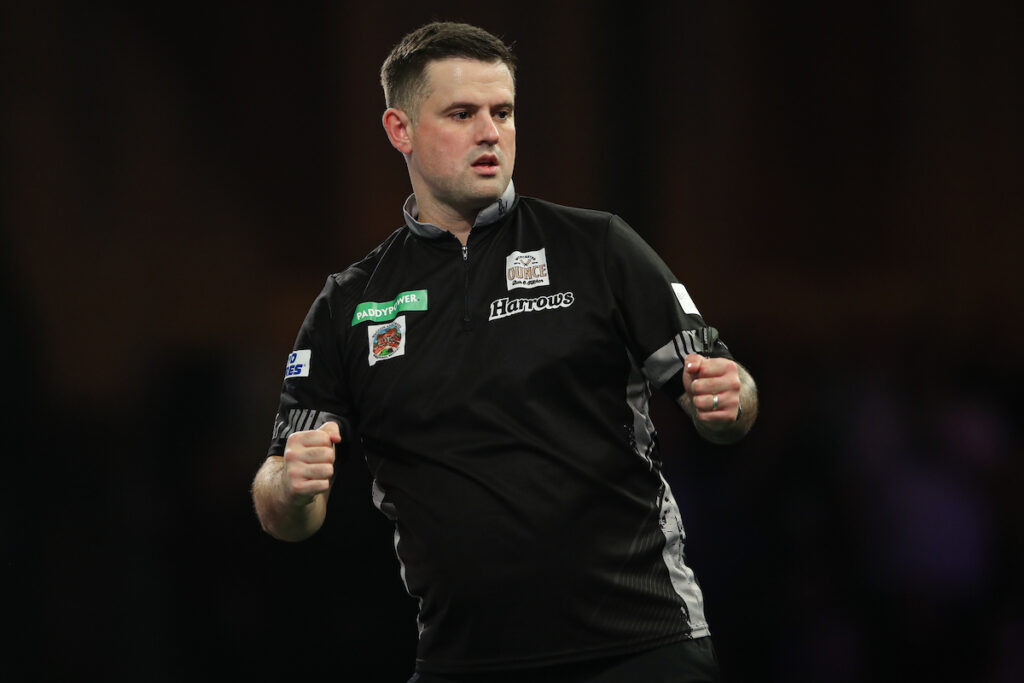
Few moments better illustrate the emotional complexity of elite darts than Woodhouse’s World Championship clash with Heta, where his close friend landed a nine-darter. Woodhouse celebrated instinctively. “People immediately suggested I was celebrating because of the prize money,” he says. “But that wasn’t it at all. I was just so happy for him.” He recalls a missed chance earlier in the event. “Then you see your mate do it on the biggest stage. That’s pure emotion.” Reflection followed. “Afterwards I did think for a moment: did I take his moment a bit? But everything worked out. It was genuine.”
Sentiment, however, has limits. Woodhouse went on to win the match. “On that stage, there are no friends,” he says calmly. “He wants to win, I want to win. That’s it.”
As the discussion drifts to music, a shared reverence emerges. Both men are devoted Queen fans, united by admiration for Freddie Mercury. “My dad always listened to Queen,” Woodhouse says. “In the car, on cassette tapes. That’s where it started.” What fascinates him most is contrast. “He was quiet, even shy. And then he stepped on stage and became someone else. That fascinated me.” The lesson lingers. “You don’t always have to be extrovert. He showed you can still be great.”
Asked for favourites, he doesn’t hesitate. “Yeah, I love it. My favourite Queen song is ‘Now I’m Here.’” He admires Adam Lambert’s interpretation but draws a personal line. “I’m a bit of a stick in the mud. For me, Queen is Freddie Mercury, so I don’t watch too much of Queen without Freddie.” Still, respect remains. “From what I’ve heard, he’s just being him. He’s not trying to be Freddie. He brings his own twist, he’s not copying what Freddie used to do.”
In a sport defined by noise and pressure, the episode offered something rarer – a portrait of calm, control, and a career shaped as much by what happens away from the oche as upon it.
—–ENDS—–
Images: PDC