
Once again, the Paddy Power World Darts Championship will convene beneath the cathedral-like glare of Alexandra Palace, where players will contest ownership of the iconic Sid Waddell Trophy which, for a while now, has taken up comfortable residency in the home of Luke Littler.
African darts has not merely been handed an opportunity – it has been granted ignition. In a proclamation that reverberated from Cairo to Cape Town, the Professional Darts Corporation ignited a structural evolution within the global game: two African qualification berths will now be enshrined within the expanding architecture of the World Championship. For a continent long orbiting the sport’s periphery, this is not incremental progress – it is tectonic recalibration.
The tournament itself retains its gladiatorial symmetry. One hundred and twenty-eight competitors will stride into battle from the very first dart, no staggered entrances, no aristocratic byes. A democratic coliseum of tungsten where once again, a £1 million cheque will dangle down from the Ally Pally rafters for the eventual sovereign, carved from an opulent £5 million prize treasury. The format remains uncompromising; the stakes, deliriously extravagant.
Few figures embody African darts’ insurgent ascent more vividly than Devon Petersen – evangelist, pioneer, and the sport’s most luminous continental emissary. Characteristically succinct yet weighted with historic gravitas, he took to social media and declared:
“This is a decision that will change the continent of Africa forever. Thank you Professional Darts Corporation”
Devon’s words were brief. The implications were colossal.
Qualification architecture has been meticulously delineated. The top 40 players from the PDC Order of Merit secure their passage by financial supremacy. They are joined by the top 40 non-qualified players from the ProTour Rankings, ensuring statistical meritocracy remains the backbone of entry.
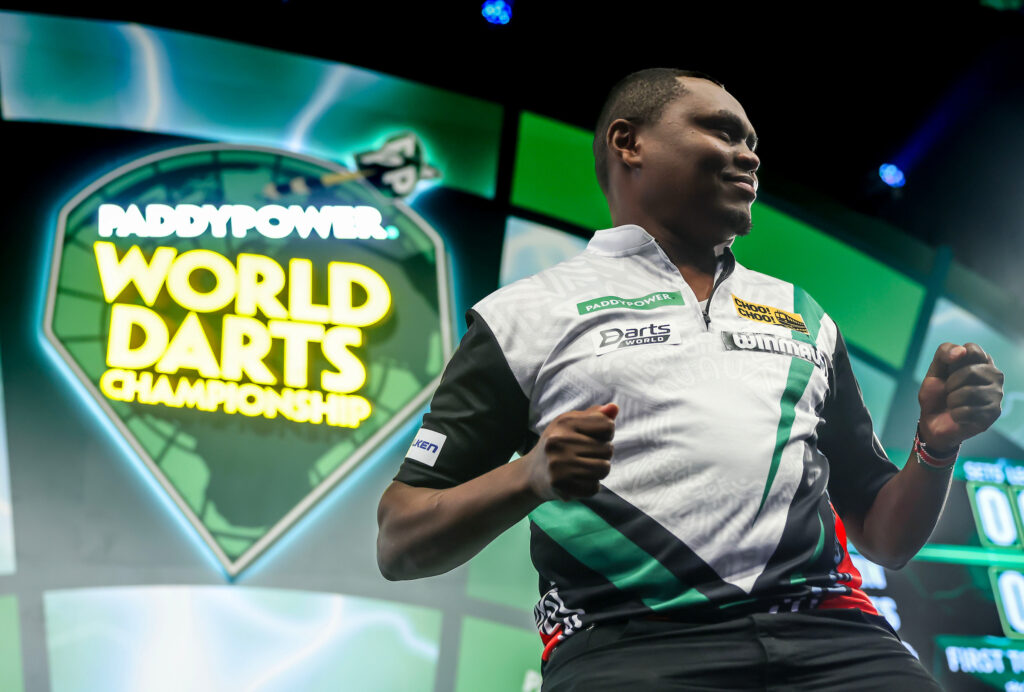
The remaining 48 positions are dispersed across the global tapestry of the sport. International qualifiers. Affiliate circuits. Secondary tours. And, most significantly, two guaranteed African positions – a landmark inclusion catalysed in part by Kenyan trailblazer David Munyua, whose fearless appearance at Alexandra Palace provided empirical proof that the continent is not participating for sentiment, but for substance.
These two historic berths will be administered via the African Darts Group, bifurcated into a Northern African Qualifier and a Southern African Qualifier – an elegant geographic equilibrium designed to ensure representation reflects the continent’s breadth rather than its loudest postcode.
Elsewhere, the qualification mosaic remains gloriously international. Five positions are reserved for the elite of the PDC Asian Tour, with two additional places awarded to the Asian Championship finalists. The PDC China Champion, alongside qualifiers from India and Japan, will each claim their own passport to London.
Across the Atlantic, five further aspirants will emerge from the Championship Darts Corporation circuit, while the Nordic and Baltic territories are allocated three positions to ensure the northern frost remains present under Ally Pally’s incandescent lights.
The women’s game retains its firm foothold: four guaranteed entrants once more, including the Women’s World Matchplay champion and the top three performers from the Women’s Series Rankings. Youthful ambition is equally fortified, with the top three players from both the Development Tour and Challenge Tour Rankings qualifying, joined by the reigning PDC World Youth Champion. A minimum of two Tour Card Holder Qualifier competitors will also penetrate the field, preserving competitive permeability.
Structurally, the tournament remains ruthlessly egalitarian. As mentioned, all 128 players commence in round one. Thirty-two seeded players and those ranked 33 to 64 will be drawn at random into the left-hand side of the bracket, confronting the remaining 64 qualifiers in a collision of pedigree versus insurgency. It is chaos by design. Hierarchy by merit. Opportunity by combat.
The championship will unfurl in December and crescendo into its January denouement, as it annually does – yet this iteration carries with it a continental inflection point. Africa is no longer knocking politely at the door of professional darts.
It has been handed the key. And this time, it is not arriving to participate. It is arriving to contend.
2026/27 Paddy Power World Darts Championship
International Qualifiers
Invited in the following order
PDC World Youth Champion
PDC Development Tour First Place
PDC Development Tour Second Place
PDC Development Tour Third Place
PDC Challenge Tour First Place
PDC Challenge Tour Second Place
PDC Challenge Tour Third Place
PDC Women’s World Matchplay Winner
PDC Women’s Series First Place
PDC Women’s Series Second Place
PDC Women’s Series Third Place
Japanese Qualifier
PDC China Championship Winner
IDC Indian Qualifier
PDC Asian Championship Winner
PDC Asian Championship Runner-Up
PDC Asian Tour Qualifier
PDC Asian Tour Qualifier
PDC Asian Tour Qualifier
PDC Asian Tour Qualifier
PDC Asian Tour Qualifier
PDCE Netherlands & Belgium Qualifier
PDCE Mediterranean Qualifier
PDCE South-East Europe Qualifier
PDCE Czechia Qualifier
PDO Polish Qualifier
PDCE DACH Super League Winner
Hungarian Super League Winner
PDC UK&IRE Tour Card Holder & Associate Member Qualifier
CDC Continental Cup Winner
CDC Cross-Border Challenge Winner
North American Championship Winner
CDC Top Ranked American
CDC Top Ranked Canadian
CDLC Qualifier
PDC Nordic & Baltic Championship Winner
PDCNB ProTour Winner
PDCNB ProTour Runner-Up
ANZ Premier League Winner
ADA Australian Tour Winner
DPNZ ProTour Winner
TBC – Aus/NZ Qualifier
African Darts Group – Northern Africa Qualifier
African Darts Group – Southern Africa Qualifier
PDC Tour Card Holder Qualifier 1
PDC Tour Card Holder Qualifier 2
Two spots TBC
—–ENDS—–
Images: PDC