Few tournaments in darts possess the kind of temporal gravity, cultural heft, and almost folkloric permanence carried by the Dutch Open Darts. Born in 1973 under the stewardship of the then British Darts Organisation and now residing within the modern framework of the World Darts Federation and the Netherlands Darts Board, the Dutch Open is not merely an event on the calendar – it is an institution, a sprawling annual convocation where history, heritage, and sheer numerical mass collide.
From its very first incarnation, the tournament announced itself as something different. The inaugural champion, home nation representative Ton Koster, overcame compatriot Geoff Kirkman – a name that sounds more like a fella from Wigan than the Netherlands – and set the tone for what would become one of the sport’s most relentlessly attended spectacles.
Thousands upon thousands would follow, transforming the Dutch Open into a logistical marvel as much as a sporting one. England soon left its own footprint too, with Terry Henney becoming the first from across the Channel to lift the trophy in 1975.
THE HISTORY OF DUTCH OPEN IN STATS AND FACTS: All you need with dartsdatabase.co.uk
The women’s event arrived in 1984, expanding the tournament’s gravitational pull still further, and it was the Netherlands once again who claimed inaugural honours through Johanna Schipper. From there, the roll of honour grew dense with excellence, evolving into a veritable encyclopaedia of elite arrow-smithing.
On the men’s side, the trophy has passed through some of the most recognisable hands the game has ever produced: Raymond van Barneveld, Steve Beaton, Wayne Mardle, and Martin Adams, with “Wolfie” standing alone atop the summit with a record four titles.
The women’s honours read just as emphatically, featuring serial champions and generational benchmarks such as Mandy Solomons, Deta Hedman, Trina Gulliver, Lisa Ashton, and more recently the ice-cold precision of Beau Greaves, who has already claimed the crown twice. In short, if a name belongs in darts royalty, chances are it has echoed through this tournament at some point.
The Dutch Open also owns a shimmering slice of broadcast mythology. In 2002, Shaun Greatbatch etched himself into immortality by producing the Netherlands’ first televised nine-darter in the final against Steve Coote, birthing the moniker The Nine Dart Man long before Brendan Dolan had his moniker created from an outstanding achievement.
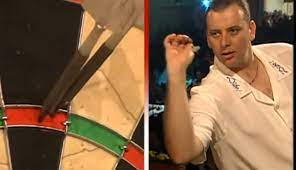
That same year marked the event’s relocation to the NH Conference Centre Koningshof in Veldhoven, where it would remain until 2014, before settling into its modern home at De Bonte Wever.
Now more than half a century old, the Dutch Open continues to regenerate rather than age. Jeffrey Sparidaans and Rhiann O’Sullivan arrive as reigning champions, while Bradley van der Velden and Paige Pauling carry the most recent youth crowns.
History is already heavy. The next chapter is waiting. And as ever at the Dutch Open, someone new is about to write their name into the granite.
—–ENDS—–
Images: WDF/NDB