
PROFILE Simply the best!
Phil Jones pays tribute to LINDA DUFFY
ON A COLD, wet and windy October weekend in 1976, a young lady travelled to Gorleston, Norfolk and thus began not only a historic chapter in London county darts but, I genuinely believe, for ladies darts as a whole.
Twenty years later the last words of the final chapter were written and the book closed. That story can now be told.
Of all the many fine players who have won the London shirt since 1966, no one, with the possible exception of Eric Bristow, has had a greater impact than Linda Duffy.
Certainly none have given greater service.
Linda’s contribution has been incalculable and her ability has, rightly, opened many doors. Along with those other early pioneers she has created a climate where ladies darts has deservedly earned respect — and not just as an appetiser for the men’s game.
But it was not always like that. Every Friday I used to go with my dad and brother to the local pub, the Windmill in Enfield, to watch them play in the Enfield & District League. I would have been about 16 at the time. They played eight a side, double start, 301 up and I would usually end up chalking the match though some teams even frowned upon a girl doing that.
There was never any question of a girl actually playing: at least not until after the match and then maybe they would humour me by allowing me to throw a few darts.
It was strictly ‘boys night out’ stuff. However, if anything is designed to ensure that Linda takes a particular course of action, then it’s someone telling her that she cannot take a particular course of action, without giving good reason, and, in 1972, she was invited to join the men’s team at The Windmill.
They were no fools, she was more than capable of beating most of them anyway. However, the Enfield and District League refused to relax their ‘men only’ rule (being beaten by a lady had just about the same amount of stigma attached to it then as it does today), and insisted that the team drop their new star player.
If they had, they may well have changed the course of ladies darts, certainly London Ladies darts, but to their credit they stuck to their guns and Linda’s talent was recognised by the league.
Applied
We applied to join the Lea Valley Super League who also had a ‘men only’ policy. But the Windmill remained adamant so Linda, no team.
Amazingly, the committee called a special AGM and passed a resolution that one lady, just one, would be allowed to play in the league — that one lady was me.
I recall that much later they would relax the rule even further to allow one lady per team. I have often wondered how many ladies have had that much influence over a men’s league.
It was a great league to play in and it brought me into contact with people like Tony Howes, Bryn Short, Willie Etherington, Tony Bell and Tommy O’Regan, all of whom had a significant impact on my early career.
In fact, it was three times N.D.A. champion Tommy O’Regan who was to introduce Linda to, as it turned out, another huge influence. A young precocious 16 year old called Eric Bristow.
Tommy took me with him to play in an Open Pairs in a Country & Western Club in Wimbledon and he introduced me to Eric who invited me to watch him play a 3001 challenge match against Alan Evans of Wales. Tommy was playing Leighton Rees on the same bill.
Little did I know in just a few short months I would be partnering Eric to victory in the North London area N.D.A. Mixed Pairs Championship, having already won the Ladies Singles — my first ‘Major’.
As it turned out it was to be the first of many ‘majors’ but because of the lack of opportunities afforded to ladies darts in those days only three people knew that, in Linda, they were looking at a very rare talent indeed. Linda herself, Eric and Linda.
From what I had seen of the standard of ladies darts, I knew that Linda was more than capable of achieving the limited goals that were available to women back then.I even remember inflicting an embarrassing defeat on the then England Men’s captain, Willie Etherington, in a local tournament sponsored by the Chestnut and Waltham Telegraph.
They backed Jimmy’s judgement and, as a result, I began the journey to the Ocean Rooms, Gorleston in Norfolk for my first London appearance.
Anybody that has ever been driven anywhere by Jim Mangan will know that important things on her mind than worrying about her debut — survival for one! Jimmy’s usual journey time was calculated as being twice the legal speed limit, plus 20mph and then double the final figure. He could have won the London-to-Pairs Air Race in his trusty Volvo!
We played the best of 3×401 and I won easily enough, 2-0. I won 2-0 on five other occasions during that first season. There were only five of us — Phyllis Blake, Anna Scott, Pat Baker, Carole Ash and myself — but we were good enough to finish inter-counties runners-up to Lancashire.
Despite that setback, 1977 was to prove an eventful year for Linda. The Ladies’ Super League was formed and immediately attracted all the top players around the London & Home Counties area.This gave Linda the level of competition that she craved.
She soon won her second ‘major’ — The St. Georges Tavern’s Singles at Willesden and Linda’s personal form was such that, in less than a year of joining London, she was selected to represent England, as a reserve, in Wales.
Although I had played only a handful of matches, I had some powerful allies in my corner, not least Olly Croft and Eric Bristow who by this time was my regular Pairs partner.
The rise from local league to England selection was meteoric but I never felt any pressure. It all seemed so natural. The Ladies’ Super League meant that I could at least meet good opposition once a week and the BDO Inter-Counties was now attracting the best players around the country.
Linda was the foundation stone of the Enfield Ladies team which scooped the jackpot during that first Super League season. I won the Singles beating June Mitchell from Kings Cross in the final and the ‘Chris Mangan Cup’ and Enfield won the Three’s and the League Championship, both of which were retained the following year.
Linda was to win the Super League Singles Title on two further occasions, in 1979-80 and 1983-84, but not in the international arena that Linda was really capable of.
Debut
She made her International debut, in Perth, Scotland, in 1978, winning against Scotland’s May Lynch, a performance that earned her Lady of the Match in what was an eventful debut. She subsequently won about 10 Lady of the Match awards.
I remember that Dave Whitcombe was also making his first appearance for England that day and, following a gee-up by the irrepressible Bristow to some very patriotic Scotsmen, the entire England party had to beat a hasty retreat in the back of the BDO lorry.
They must have been upset because it was covered in beer and it takes a lot to prise a pint out of a Scot.
Also a member of that victorious England team was, perhaps, the only other lady player who was to achieve the same kind of success as Linda — Maureen Flowers.
I first met Maureen in 1977 at the Indoor League and got to know her when selected as England reserve later that year. However, it was not until the final of the Pony Ladies’ Singles, at Great Yarmouth, that we met in competition. I lost on that occasion by 3-2 but got my revenge in both my finals of the British Open Championship.
As much as I respected other players at the time like the Welsh pair of Sandra Gibb and Janet Dewan and Margaret Lally and Ann Westwood, there is no doubt in my mind that Maureen was to become my great adversary and, in many ways, my hardest opponent.
I would like to think that whilst we were not exactly what you might call ‘close friends’, we had a healthy respect for each other. I did feel that there were times when the other top players were intimidated by me, but Maureen never was. We had some classic battles.
However, in 1978 international horizons were beckoning as the BDO started to look further afield for their members to scoop the jackpot.
Even in these relatively early days for top class darts there was a tremendous amount of competition and I don’t mean competition as in events but in rivalry.Not all of it was ‘friendly’ and the opportunity to get an advantage over an opponent by spotting a weakness and exploiting it to the full was part and parcel of the game.
There were some fierce rivalries beginning to form in both the men’s and ladies’ codes (not surprisingly really when Bristow and Bobby George got on the ‘wind-up’ bandwagon) so I really enjoyed the trips abroad especially when all of us were representing England in America.
There is no doubt that there was a kind of ‘bonding’ which temporarily put all local rivalries on hold.I seem to recall that Bristow said that he didn’t mind teaching the Yanks the game providing they remembered who were the masters and who were the pupils.
Chuffed
I was part of ‘Team Durro’ along with Eric, Bobby George and Pat Piper. In 1978 I made my first trip to America and reached the semi-final of the North American Open, losing to the eventual winner Kathy Karpowich.
By taking three successive singles championships at the Butlins Easter Gala tournament, always a very competitive event. She was to make it four wins in five attempts when again lifting the title in 1982. It was only a matter of time before Linda won the big one and that, in 1980, could only mean the British Open.
I can remember it as though it were yesterday, and even though I faced Maureen Flowers in the final I never had any doubt that I would emerge champion.
Being my first major championship it will always hold very special memories but probably not as much as the second time I won the title in 1985. In those days the Open was televised and I bought my mum a portable television so that she could watch the championship from her hospital bed.
You can imagine how proud she was to see me lift the trophy when I again beat Maureen in the final. Three years earlier I had partnered Maureen to win the British Open Pairs in what was one of the few occasions we teamed up.
It was the 1980 success that convinced Linda to turn professional and she turned to a great friend of darts, Harry Kicks, Snr of Winmau.
I had a great relationship with Harry, a man I admired tremendously. He fixed me up with some exhibitions at RAF bases and I also represented Pony, who sponsored ladies’ darts for a while in the late seventies and early eighties.
My first major victory on American soil remains one of my fondest memories — the 1983 Golden Gate Classic Open.
During subsequent years a whole host of international honours were to find their way into the Enfield trophy cabinet, as North American tour titles were joined with top European Championships in Denmark, Sweden and Finland.
On the home front there were equally big fish to fry.
When I started out I had three main ambitions: to be No. 1 in the world, to play for England and to win the British Open which was the premier ladies’ event at the time. I achieved all three and much, much more.
As a preamble to her first British Open success in 1980, Linda warmed up by taking three successive singles championships at the Butlins Easter Gala tournament, always a very competitive event.
Today if a lady player admitted to having two sponsors the next question would probably be what planet she was from. I remember that in 1981 Maureen and I made veiled threats of withdrawing from the England scene unless concerted efforts were made to include the women in major events like the Europe and World Cups.
Prize
I once referred to Linda as the ‘Arthur Scargill’ of ladies’ darts when she represented the rest of the London Ladies squad in asking for 50 per cent of the prize money for winning the Inter Counties championship.
Darts World, October 1996, pages 29–30
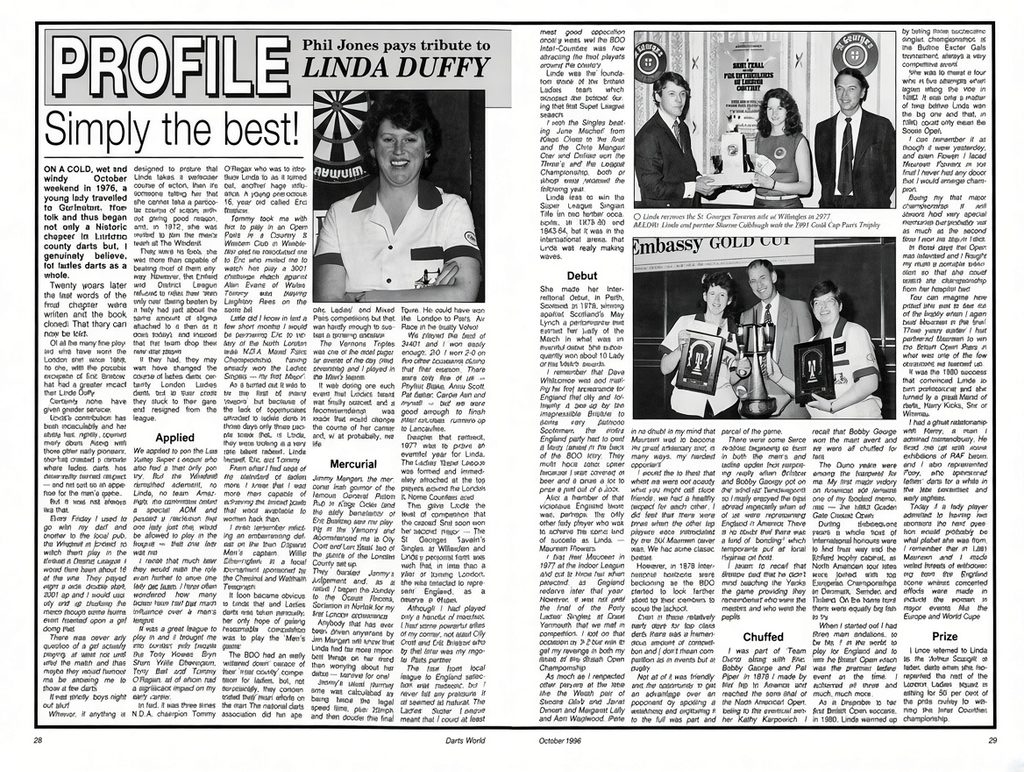
Photo captions
Linda receives the St. Georges Taverns title at Willesden in 1977
BELOW: Linda and partner Sharon Colclough with the 1991 Gold Cup Pairs Trophy
(Photos of Linda holding trophies and posing with the Embassy Gold Cup also appear on the spread.)
PROFILE: (continued from previous pages)
Linda can be pretty persuasive, and determined, and the ladies got their share of the loot. In the same fashion, the ladies also got their European Cup, in 1982, and, a year later, the World Cup.
The European was played in Essex and appropriately ‘the ultimate Essex Man’ Bobby George won the Men’s Singles and I finished 3rd in the Ladies’ event, losing in the semi-final to Anne-Marie Davies of Wales even though I had 16 darts in the last 3 legs to win.
In an all-Welsh final Sandra Gibb, who married my very good friend Dave Lee, beat Anne-Marie. That weekend I really felt that ladies’ darts had finally arrived and a couple of years later I knew that they had, at least on a personal level.
Europe II was held in The Hague and I won the Singles, beating Sharon Kemp in the final and paired up with Sharon to take the Pairs title as well.
In many respects the European and World Cup events are unique in darts in as much as you get the added bonus of being able to win for yourself and, at the same time, for your country.
I remember thinking as I was presented with the Ladies’ European Championship Trophy, ‘today Europe, tomorrow the world’. Yes, I know it’s a cliché — but less than a year later it was to come true.
Ladies’ darts was at last making international headway and a year after the inaugural European Championship, the ladies travelled to Scotland for the Ladies’ World Cup. It was World Cup IV for the men, World Cup I for the ladies, but World Cup 0 for Linda.
I can honestly say that, as I now reflect upon 20 years at the top of ladies’ darts, there have been few occasions which, even today, I feel a great deal of disappointment and regret.
Not being selected for World Cup I was among the very few times I have been left totally disillusioned with darts. I was No. 3 in the World Rankings behind Maureen and Anne-Marie Davies, who was Welsh, 2nd in the current county averages which covered every player eligible for England selection and, if that were not enough, I still had an unbeaten record for England.
Sometimes I feel that politics plays too big a role in what is basically a simple sport. That was true in 1982 as it is today.
Roger Nickson, mine host of the Morning Star, Peckham, was to provide Linda with a very handy diversion during World Cup week, a trip to Lloret de Mar.
The Lloret trips were like always great fun and just what I needed. Not that I can remember too much about that particular one other than it was very, very wet — on the inside not on the outside!
World Cup II was held in Brisbane, Australia and this time Linda was selected to make the trip.
As the reigning European Singles and Pairs champion I suppose I had made it impossible for the selectors to ignore my claim, but the chance to say ‘I told you so’ was too good to pass up.
Linda did not pass up the chance, winning not only the Singles but also the Pairs with her European Championship winning partner, Sharon Kemp.
If that were not enough for the selectors to chew on she also added the prestigious Pacific Masters title to her growing list of honours.
I loved everything about Australia and stayed on to tour the country for three weeks during which time I did not lose one game.
I had achieved what very few sports people ever have the opportunity or the ability to achieve — I was World Champion in my chosen sport!
It may have been the pinnacle of Linda’s career but it was certainly not the end of it. She retained the European Pairs title, this time partnering Surrey’s Jane Kempster, and joined with fellow London county player, Sharon Colclough in dominating the Gold Cup Pairs in the early ’90s.
By this time, Linda had more important things to consider in her life.
On one of her visits to Roger Nickson’s ‘Morning Star’ pub in Peckham, South London, she met a mercurial Irishman who had long since kissed the Blarney stone, Tom Duffy, though it was not exactly ‘instant Karma’!
We first met in 1983 but it wasn’t until three years later that we started dating regularly, and a further two years before we got married.
Sons Rory and Myles completed the pictures in the family album. Linda has just completed a three year university course during which she gained a BSc (Hons) in Psychology, a fact which should astound the critics who think that a dart player’s brains are normally encased in a pair of trousers.
I’ve been offered the chance to take a further three year course for my PhD, which I intend to do, but I’ll be working at the same time which will leave practically no time for darts.
I asked Linda what were her own special moments in a long and glittering career.
With very few exceptions, I enjoyed every moment of it. I set out to be the best there was and, I think, for a time, I achieved that.
World Champion, European Champion, British Champion, World No. 1, England Captain — I think most people would say that I was ‘reasonably successful’.
Another high spot was when my London County colleague Keith Deller came from nowhere to win the 1983 Embassy World Championship. I can remember throwing every single dart with him!
You place a great deal of emphasis on your time with London.
Yes, especially during the 80s with Eric, Cliff, Keith, Steve Brennan and Terry O’Dea plus Mina Nightingale and the likes of Lew and Danny Shannon, Tiny Goodair and yourself.
They were great times, we had a great team with great supporters.
Did you think that you got the respect of the people who were running the game, bearing in mind that you never won the BDO Sports Personality award for women, even during the period you were European and World Champion?
I admit I was not slow to voice my opinion on certain matters when and where I felt necessary, but if I, and other players like Maureen, had not pushed for the ladies’ cause there may not even be the limited opportunities that exist today.
We were years behind the men in terms of international competition so standing in a corner like the subservient lady was obviously not going to get things moving. Sometimes people objected to that, and perhaps they still do.
Leaving modesty aside, who were the players that you considered the best of your time?
I have already mentioned Maureen Flowers but I have a great regard for Mandy Solomons from the current era. I could not separate Eric and John Lowe from the men’s game and Bobby George had no rivals as the most entertaining player.
In his superb chronicle of the Greater London Darts Organisation, Roger Nickson described the emergence of Linda as being ‘an event of unparalleled importance in the history of London ladies’ darts’. Few would disagree.
She has been a pioneer in ladies’ darts and a cornerstone of the London set-up. Icons are never replaced neither shall Linda be.
For me she will be remembered as ‘simply the best’.
(Darts World, October 1996, pages 30–31 (column left))
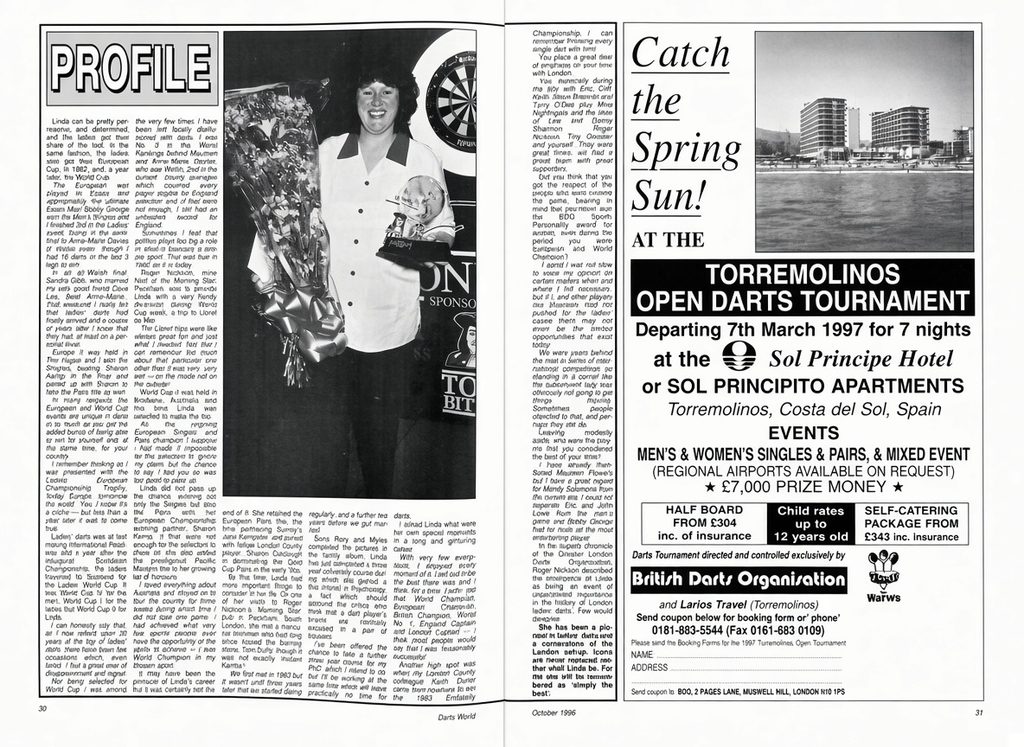
(The right-hand page is dominated by a full-page advertisement for the Torremolinos Open Darts Tournament, departing 7th March 1997 for 7 nights at the Sol Principe Hotel or SOL PRINCIPITO APARTMENTS, Torremolinos, Costa del Sol, Spain. Events: Men’s & Women’s Singles & Pairs, & Mixed Event. £7,000 prize money. Half board from £304, child rates, self-catering packages. Organised by British Darts Organisation and Larios Travel.)
This is a digitized version of an article from Darts World magazine’s print archive, before the start of online publication in the 2010s. To preserve these articles as they originally appeared, we does not alter, edit or update them. The digitisation/restoration process introduces transcription errors or other problems that are not the fault of the original authors or editors; we are continuing to work to improve these archived versions
Images: Darts World magazine ( Issue 287 ) October 1996