

JOHN PART picked up his first major title since the World Championships in 2003 when he defeated Raymond Barneveld 6-3 in the final to lift the Desert Classic darts crown in Las Vegas early last month.
He then declared that, whilst he hadn’t been at his very best, he had been the most persistent player of the tournament.
“I’ve switched from being consistent to being persistent,” he told Sky Sports presenter Dave Clark, a wide and happy smile on his face.
The Canadian had, indeed, proved himself the most durable in the desert. He had come from behind and had survived a match point against him in his quarter-final battle with Terry Jenkins, then turned a 2-0 deficit against Wes Newton in the semi-finals into a 4-2 success, before coming from a set down to beat recent UK Open winner Raymond Barneveld and take the £15,000 main prize.
He had as tough a passage to the final as anyone could have had, beating Ronnie Baxter 6-3 in the opening round, Roland Scholten 3-0 in the second, a suitable result on his 40th birthday, one of the PDC’s quickest rising stars, Terry Jenkins and a man playing in his second consecutive semi-final in Las Vegas, Wesley Newton.
INTERESTED IN GLOBAL DARTS? Checkout DartsWorld’s Dedicated Area
Add to all that the fact that he had been required to qualify for the event on the days preceding the main event, and the size of Part’s achievement becomes all the more remarkable. He had beaten Michael Barnard, Colin Osborne and Steve Maish in order to make it into the Desert Classic.
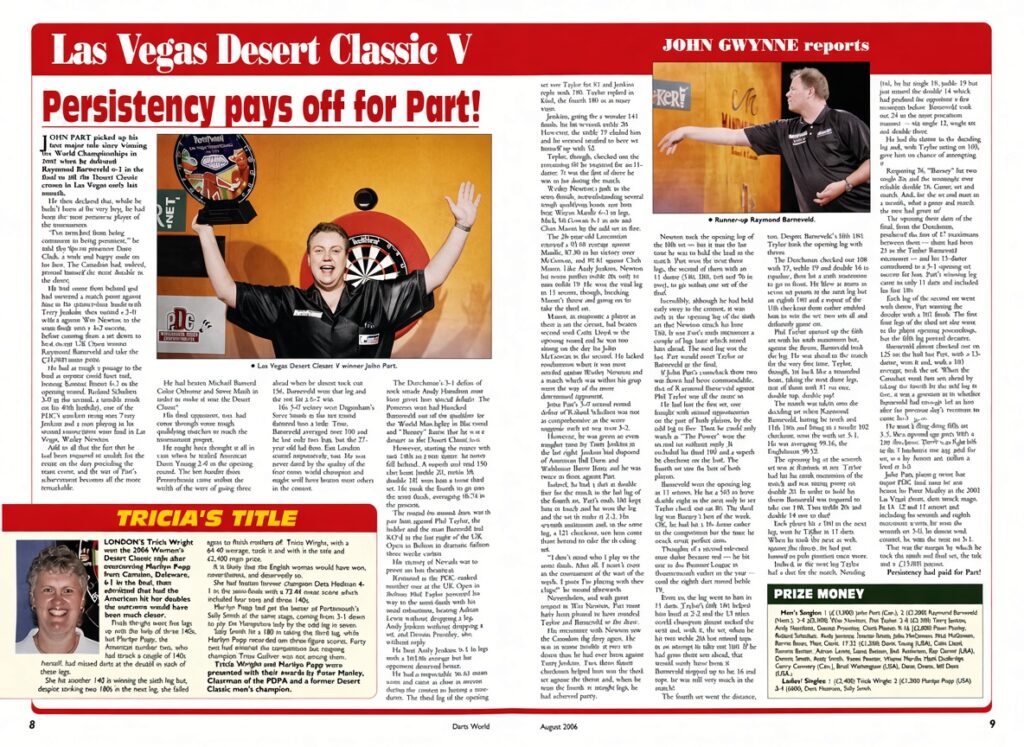
His final opponent, too, had come through some tough qualifying matches to reach the tournament proper.He might have thought it all in vain when he trailed American Darin Young 2-0 in the opening round. The left-hander from Pennsylvania came within the width of the wire of going three ahead when he almost took out 156. Barneveld won that leg and the rest for a 6-2 win.
His 3-0 victory over Dagenham’s Steve Smith in the next round flattered him a little. True, Barneveld averaged over 100 and he lost only two legs, but the 27-year-old lad from East London scored impressively too. He was never fazed by the quality of the four-times world champion and might well have beaten most others in the contest.
The Dutchman’s 3-1 defeat of rock-steady Andy Hamilton must have given him special delight. The Potteries man had knocked Barneveld out of the qualifiers for the World Matchplay in Blackpool and “Barney” knew that was a danger in the Desert Classic, too.
However, starting the match with two 180s in a ten-darter, he never fell behind. A superb and vital 150 checkout (treble 20, treble 18, double 18) won him a tense third set. He took the fourth to go into the semi-finals, averaging 98.74 in the process.
The round-by-round draw was to pair him against Phil Taylor, the holder and the man Barneveld had KO’d in the last eight of the UK Open in Bolton in dramatic fashion three weeks earlier.
“I don’t mind who I play in the semi-finals. After all, I wasn’t even in the tournament at the start of the week. I guess I’m playing with their chips!” he mused afterwards.
Nevertheless, and with great respect to Wes Newton, Part must have been pleased to have avoided Taylor and Barneveld in the draw. His encounter with Newton saw the Canadian dig deep again. He was in worse trouble at two sets down than he had ever been against Terry Jenkins. Two three-figure checkouts helped him win the third set against the throw and, when he won the fourth in straight legs, he had achieved parity.
The third leg of the opening set saw Taylor hit 81 and Jenkins reply with 180. Taylor replied in kind, the fourth 180 in as many visits.Jenkins, going for a wonder 141 finish, hit his seventh treble 20. However, the treble 19 eluded him and he seemed satisfied to have set himself up with 52.Taylor, though, checked out the remaining 60 he required for an 11-darter. It was the first of three he was to hit during the match.
Wesley Newton’s path to the semi-finals, notwithstanding several tough qualifying bouts, saw him beat Wayne Mardle 6-3 in legs, Mick McGowan 3-1 in sets and Chris Mason by the odd set in five. The 28-year-old Lancastrian enjoyed a 93.68 average against Mardle, 87.80 in his victory over McGowan, and 89.81 against Chris Mason.
Like Andy Jenkins, Newton hit seven perfect treble 20s only to miss treble 19. He won the vital leg in 11 arrows, though, breaking Mason’s throw and going on to take the third set. Mason, an enigmatic a player as there is on the circuit, had beaten second seed Colin Lloyd in the opening round and he was too strong on the day for John McGowan in the second. He lacked resoluteness when it was most needed against Wesley Newton and a match which was within his grasp went the way of his more determined opponent.
John Part’s 3-0 second round defeat of Roland Scholten was not as comprehensive as the score suggests: each set was won 3-2.
However, he was given an even tougher time by Terry Jenkins in the last eight. Jenkins had disposed of American Bill Davis and Welshman Barrie Bates and he was twice in front against Part. Indeed, he had a dart at double five for the match in the last leg of the fourth set.
Part’s sixth 180 kept him in touch and he won the leg and the set to make it 2-2. His seventh maximum and, in the same leg, a 121 checkout, saw him come from behind to take the deciding set.Restored as the PDC-ranked number one at the UK Open in Bolton, Phil Taylor powered his way to the semi-finals with his usual robustness, beating Adrian Lewis without dropping a leg, and Dennis Priestley, also without reply.
He beat Andy Jenkins 9-1 in legs with a 103.86 average but his opponent deserved better.He had a respectable 96.61 mean score and came as close as anyone during the contest to hitting a nine-darter. The third leg of the opening set saw Taylor hit 81 and Jenkins reply with 180. Taylor replied in kind, the fourth 180 in as many visits.Jenkins, going for a wonder 141 finish, hit his seventh treble 20.
However, the treble 19 eluded him and he seemed satisfied to have set himself up with 52.Taylor, though, checked out the remaining 60 he required for an 11-darter. It was the first of three he was to hit during the match.
Newton took the opening leg of the fifth set — but it was the last time he was to hold the lead in the match. Part won the next three legs, the second of them with an 11-darter (140, 180, 105 and 76 in two), to go within one set of the final.Incredibly, although he had held early sway in the contest, it was only in the opening leg of the sixth set that Newton struck his lone 180.
It was Part’s sixth maximum a couple of legs later which nosed him ahead. The next leg was the last. Part would meet Taylor or Barneveld in the final.If John Part’s comeback from two sets down had been commendable, that of Raymond Barneveld against Phil Taylor was all the more so.
He had lost the first set, one fraught with missed opportunities on the part of both players, by the odd leg in five.
Then he could only watch as “The Power” won the second set without reply. It included his third 180 and a superb 86 checkout on the bull. The fourth set saw the best of both players.Barneveld won the opening leg in 11 arrows. He hit a 165 to leave double eight in the next only to see Taylor check out on 80.
The third leg was Barney’s best of the week. OK, he had hit a 10-darter earlier in the competition but this time he struck seven perfect darts. Thoughts of a second televised nine-darter became real — he hit one in the Premier League in Bournemouth earlier in the year — until the eighth dart missed treble 19. Even so, the leg went to him in 11 darts.
Taylor’s fifth 180 helped him level at 2-2 and the 13 times world champion almost nicked the next and, with it, the set, when he hit two treble 20s but missed tops in an attempt to take out 160. If he had gone three sets ahead, that would surely have been it.Barneveld stepped up to hit 16 and tops; he was very much in the match!
The fourth set went the distance, too. Despite Barneveld’s fifth 180, Taylor took the opening leg with a throw. The Dutchman checked out 108 with 19, treble 19 and double 16 to equalise, then hit a sixth maximum to go in front. He blew as many as seven set points in the next leg but an eighth 180 and a repeat of the 108 checkout from earlier enabled him to win the set two sets all and definitely game on.Phil Taylor opened up the fifth set with his sixth maximum but, against the throw, Barneveld took the lead. He was ahead in the match for the very first time.
Taylor, though, hit back like a wounded beast, taking the next three legs, one of them with 81 via one, double top, double top! The match was taken into the deciding set when Raymond Barneveld, hitting his tenth and 11th 180s and firing in a timely 102 checkout, won the sixth set 3-1. He was averaging 99.16, the Englishman 98.52. The opening leg of the seventh set was as dramatic as any. Taylor had hit his ninth maximum of the match and was sitting pretty on double 20.
In order to hold his throw Barneveld was required to take out 148. Two treble 20s and double 14 saw to that!Each player hit a 180 in the next leg, won by Taylor in 11 darts. When he took the next as well, against the throw, he had put himself in pole position once more.
Indeed, in the next leg Taylor had a dart for the match. Needing 104, he hit single 19, treble 19 but just missed the double 14 which had profited his opponent a few moments before. Barneveld took out 24 in the most precarious manner — via single 12, single six and double three. He had the throw in the deciding leg and, with Taylor sitting on 103, gave him no chance of attempting it.
Requiring 76, “Barney” hit two single 20s and the seemingly ever reliable double 18. Game, set and match. And, for the second time in a month, what a game and match the two had given us!
The opening three darts of the final, from the Dutchman, produced the first of 17 maximums between them — there had been 23 in the Taylor/Barneveld encounter — and his 13-darter contributed to a 3-1 opening set success for Part. Part’s winning leg came in only 11 darts and included his first 180.
Each leg of the second set went with throw, Part winning the decider with a 101 finish. The first four legs of the third set also went to the player opening proceedings, but the fifth leg proved decisive.Barneveld almost checked out on 125 on the bull but Part, with a 13-darter, won it and, with a 103 average, took the set.
When the Canadian went two sets ahead by taking the fourth (he odd leg in five, it was a question as to whether Barneveld had enough left in him after the previous day’s exertions to come back. He won a ding-dong fifth set 3-2, then opened the sixth with a 170 (the second 170 of the week) but left himself on 32 in the deciding leg only to see Part check out 86 on the bull for a 3-1 win and a 3-3 level at 3-3.
John Part, playing in his first major PDC final since he was beaten by Peter Manley in the 2003 Las Vegas event, then struck magic. In 14, 12 and 11 arrows and including his seventh and eighth maximum scores, he won the seventh set 3-0. In almost total control, he won the next set 3-1. That was the margin by which he took the ninth and final set, the title and a £15,000 payout.
Persistency had paid for Part!
Las Vegas Desert Classic V Darts (2006)
PRIZE MONEY
Men’s Singles:1 (£15,000) John Part (Can)
2 (£7,500) Raymond Barneveld (Neth)
3-4 (£5,000) Wes Newton, Phil Taylor
5-8 (£2,500) Peter Manley, Roland Scholten, Andy Jenkins, Steve Smith, John McGowan, Mick McGowan, Barrie Bates, Matt Clark
9-16 (£1,350) Darin Young (USA), Colin Lloyd, Ronnie Baxter, Adrian Lewis, Brad Beeston, Bob Anderson, Ray Carver (USA), Dennis Smith, Andy Smith, Kevin Painter, Wayne Mardle, Mark Dudbridge, Gerry Convery (Can), Steve Washington (USA), Denis Ovens, Bill Davis (USA)
Ladies’ Singles:1 (£2,400) Tricia Wright2 (£1,200) Marilyn Popp (USA)3-4 (£600) Deta Hedman, Sally Smith
Report: JOHN GWYNNE in Darts World Magazine (Issue 405) August 2006
Images: PDC
Page Graphic – DartsWorld Ltd