
Our series on the PDC World number ones has stimulated thoughts on the relative merits of systems and players alike, part three looks at a time when the tour was beginning to develop but there was a divergence between rewarding the travelling darts professional and acknowledging the different nature of winning televised, ranked ‘major’ events.
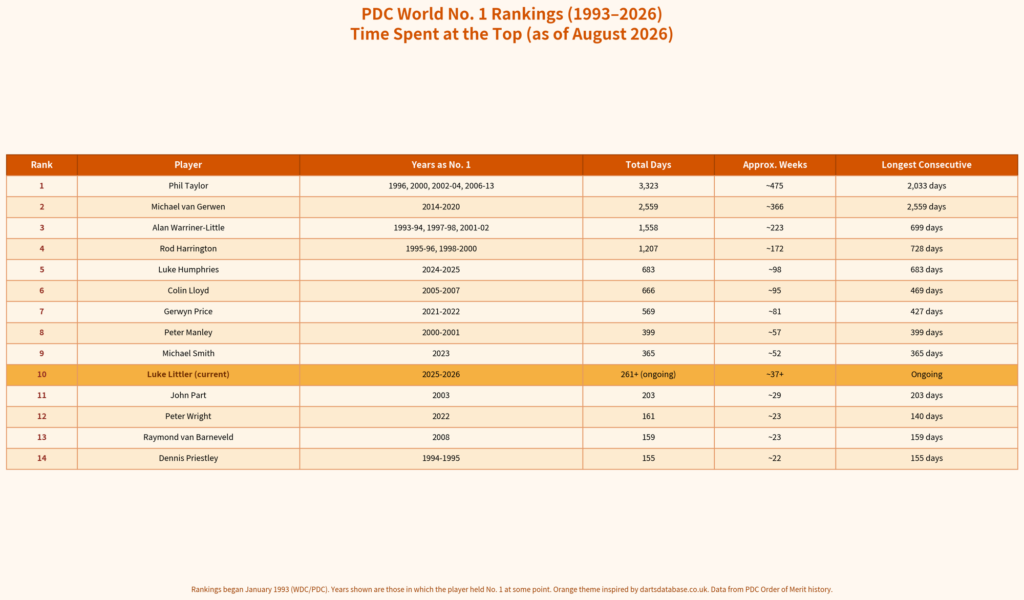
Colin “Jaws” Lloyd sits sixth on the all-time list with approximately 666 days as PDC World Number One. His reign covered most of 2005 and 2006 and remains one of the clearest illustrations of how the old points-based ranking worked.
DARTS IS A NUMBERS GAME: More Stats and Facts Pieces Here
Lloyd first reached the summit on 27 February 2005 after strong results on the Pro Tour, including the West Tyrone Open. He held the position for 469 consecutive days until mid-June 2006. Phil Taylor briefly interrupted him for just seven days (still the shortest consecutive reign in PDC history) before Lloyd reclaimed the top spot on 18 June 2006 and kept it for another 197 days through the end of the year.
The former builder finally lost the ranking after the 2007 World Championship, coinciding with the switch to the pure prize-money Order of Merit. Unlike some earlier Number Ones, Lloyd did win major titles during this period. is dartsdatabase.co.uk profile is highly impressive.
Jaws claimed the 2004 World Grand Prix (beating Alan Warriner-Little in the final) and, shortly after becoming world number one, added the 2005 World Matchplay in memorable fashion. In the final against John Part he finished on a 170 checkout – one of the most celebrated moments of that era. He also reached the Premier League final in 2005 and several other deep runs in majors.
Yet, the bulk of the points that kept him at the top came from sheer volume. Lloyd was a regular on the non-televised circuit, playing far more ranking events than most of his contemporaries. Under the points system there was no limit on how many tournaments counted, so consistent travellers could out-accumulate players who focused more on the big televised majors.
DARTS PLAYER MERCHANDISE AND COLLECTABLES AT OUR DARTSWORLD STORE!
Critics sometimes questioned whether the ranking accurately reflected the best player in the world at the time, but Lloyd himself was always realistic about it: he worked hard, supported the tour, and accumulated the points the system rewarded.
The supporting of the tour is much more valuable than may today seem the case. For much of its early life the PDC struggled to survive and than to expand and finally to provide an income. Players paid entry fees, and their expenditure on food and drink etc. was why venues hosted the competitions at all.
His two-year spell as Number One therefore bridges the early pioneers Warriner-Little, Priestley, Harrington and Manley – as highlighted in our Originals follow-up – and the later pure prize-money era. The now 53-year-old’s spells at the top stand as both an immense personal achievement and a snapshot of a ranking system that valued consistency and commitment to the full calendar as much as major silverware.
Our final close up on the PDC’s short but distinguished list of numbers ones will look at another unique period and the rise of Luke Littler!
More on this subject – World Number Ones: Humphries Shines
Images: PDC