
Teenage sensation, Luke Littler has advocated for a substantial structural recalibration of the Premier League Darts format, expressing a clear preference for the reinstatement of the competition’s former configuration and, in particular, the return of the much-discussed concept known as “Judgement Night.”
Since 2022, the Professional Darts Corporation has utilised an eight-player format in which competitors contest weekly miniature knockout tournaments across a sixteen-week travelling schedule.
MORE ELITE DARTS COVERAGE: Check Out Our Devoted PDC Area
While commercially successful and capable of generating compelling narratives, the format has also attracted persistent scrutiny from sections of the fanbase who have questioned whether repeated encounters between the same elite players have diluted the novelty that once characterised the competition. Few individuals have benefitted more from the current arrangement than Littler himself.
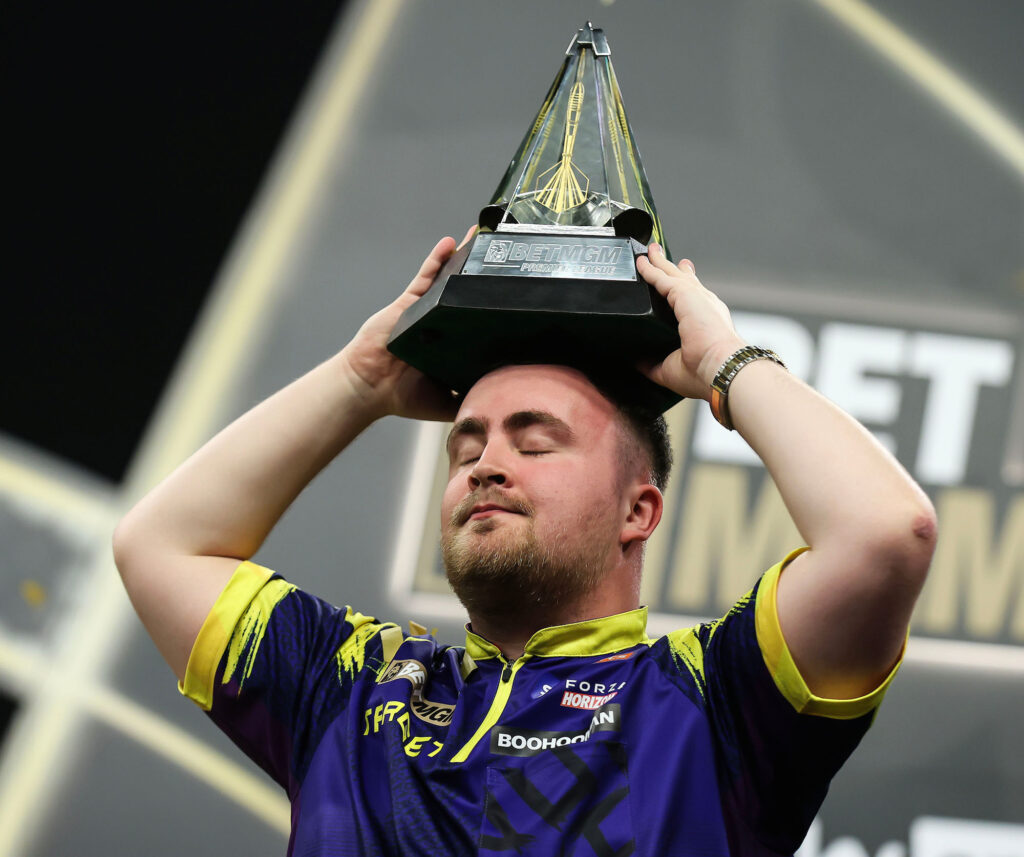
Since entering the Premier League in 2024, the reigning world number one has established himself as one of the event’s dominant protagonists, capturing the title on two occasions whilst also finishing as runner-up. Nevertheless, despite his remarkable success under the existing structure, the Warrington phenomenon believes alternative formats deserve serious consideration.
Speaking to SportsBoom, Littler outlined his preference for a return to the ten-player system previously employed by the PDC. He said:
“I’d like to see a change. I’d like to play in a Premier League where it’s just one game a night.
“Get an extra two players in, get a judgement night back in as well, because that’s what I grew up watching.
“It was very, very interesting to see obviously two Premier League players go with your 10th and 9th and then the other eight can battle it out.
“If it’s not working, then change it, but if it’s working for the PDC, then just keep it in place.”
The format to which Littler refers was last utilised in 2021 and possessed a distinctly different competitive architecture. Each participant contested a single fixture per evening, creating a more traditional league environment.
After the ninth week, the competitors occupying ninth and tenth positions in the standings were eliminated, thereby reducing the field to eight players.
The remaining contenders subsequently embarked upon an increasingly intense battle for the coveted play-off berths and the opportunity to compete at London’s O2 Arena.
For many supporters, the former system generated an additional layer of strategic intrigue. The looming threat of elimination created an atmosphere of cumulative jeopardy, with league positions carrying heightened significance as Judgement Night approached.
Debate surrounding the competition’s future has intensified in recent seasons, particularly as spectators have become increasingly vocal regarding the frequency of recurring match-ups.
With only eight participants involved, high-profile encounters inevitably recur throughout the campaign, prompting ongoing discussion concerning competitive variety and long-term sustainability.
PDC Chief Executive Matt Porter recently acknowledged that the organisation remains receptive to evaluating potential modifications. He stated:
“We try and balance it and find the right answers.
“Obviously, you are never going to please everybody with everything that you do.
“I think whilst people are talking about it that shows they care, and we can’t ask much more than that.
“We’ve had it for four years, we wouldn’t have it for eight years.
PDC POWERS LOOKING AT PREMIER LEAGUE DARTS REVAMP?
“So, if you look at the life cycle of it then it will certainly be in that part than the ascendency.
“You are never going to pick something that will please everyone, but we will always look at what we can do.
“So, watch this space.”
Porter’s remarks stop short of confirming imminent reform, yet they nevertheless indicate that the PDC recognises the evolving conversation surrounding one of its flagship properties.
Whether the organisation ultimately opts for evolutionary adjustment or comprehensive restructuring remains uncertain.
What is increasingly apparent, however, is that discussions regarding the Premier League’s future configuration are no longer confined to supporters alone.
DARTS PLAYER MERCHANDISE AND COLLECTABLES AT OUR DARTSWORLD STORE!
When the competition’s most successful contemporary figure begins advocating for change, the debate inevitably acquires considerably greater significance.
——ENDS—–
Images: PDC