
Every darts player has been there.
One week you’re convinced your throw is the problem. The next you’re copying Luke Littler’s rhythm, trying Gary Anderson’s follow through or scouring YouTube for the latest coaching tip that promises to transform your game.
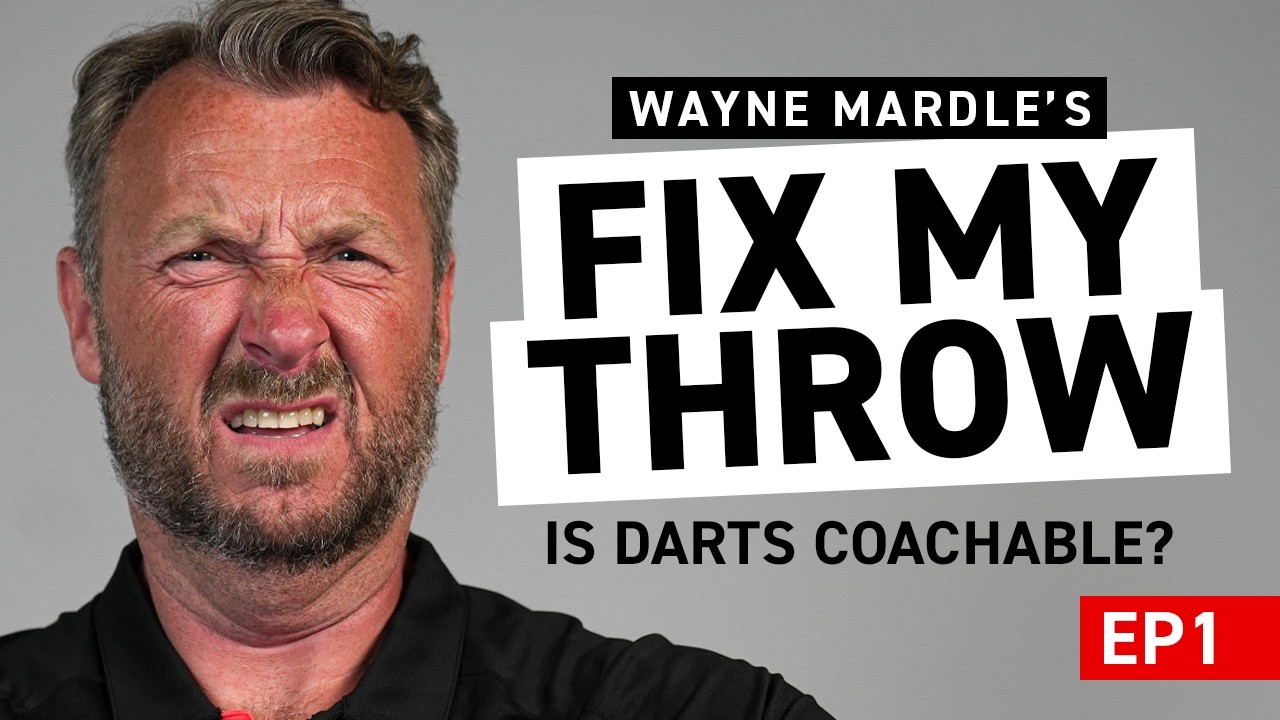
Wayne Mardle’s new series, Fix My Throw, takes a very different approach.
Instead of tearing apart players’ actions or insisting there’s one ‘correct’ way to throw a dart, the former World Championship semi-finalist analyses submissions from players around the world, offering practical advice centred around one overriding principle: understand your own throw before trying to change it.
“Darts is coachable,” Mardle explains early in the opening episode, before adding an important caveat. “I wouldn’t say everyone needs coaching. They just need the odd tip here and there.”
PLAY BETTER DARTS – The DartsWorld Dedicated Practice, Coaching and Improvement Area
That philosophy underpins everything that follows.
Rather than rebuilding a player’s technique from the ground up, Mardle searches for the smallest adjustments that can produce the biggest improvements. Whether it’s a slight pause in the action, a grip that’s become too complicated or a follow-through lacking conviction, his focus is on refinement rather than reinvention.
Perhaps the most refreshing aspect of the series is Mardle’s willingness to challenge one of the biggest misconceptions in amateur darts: that successful players should try to imitate the professionals.
Using examples including James Wade and Nathan Aspinall among others, Mardle points out that even some of the world’s best players possess technical flaws. The difference, he argues, is that their natural ability allows them to repeat those actions consistently.
“We all want to throw like Adrian Lewis, Gary Anderson, Michael Smith, Luke Littler or Luke Humphries,” he says. “But we can’t because that’s not us.”
It’s a simple message, but an important one. Every player develops their own natural rhythm, and forcing yourself to copy somebody else’s action often creates more problems than it solves.
That emphasis on rhythm becomes one of the defining themes of the episode. When asked what is hardest to coach, Mardle’s answer isn’t grip, stance or follow-through. It’s rhythm.
From Dennis Priestley’s measured approach to Justin Pipe’s famously deliberate routine, Mardle argues that every successful player possesses a natural fluency, regardless of how unconventional it might appear. The objective isn’t to speed players up or slow them down, it’s to help them find a routine that feels repeatable under pressure.
“Whilst it has to be natural,” he explains, “if it’s not, you are swimming against the tide.”
It’s an observation that carries through every submission he reviews.
One young player is praised for his posture and effortless rhythm. Another is advised to relax after unnecessary tension creeps into his action. In almost every case, Mardle begins by highlighting what the player already does well before suggesting one or two manageable improvements.
There is no attempt to overwhelm viewers with technical jargon or encourage wholesale changes. Instead, Mardle explains why a particular movement might become inconsistent over time, helping players understand the relationship between cause and effect within their own throw.
One of the opening episode’s most thought-provoking moments comes when Mardle discusses awareness.
“If you’re hitting a treble 20, then a treble 12 felt the same, you’re not getting your throw. You don’t understand it.”
DARTS PLAYER MERCHANDISE AND COLLECTABLES AT OUR DARTSWORLD STORE!
For elite players, he explains, every dart has a different feel leaving the hand. Understanding those sensations allows players to identify mistakes before the dart even reaches the board, a level of self-awareness that many amateurs never consciously develop.
It’s an insight that perfectly captures what Fix My Throw is trying to achieve. Rather than providing a list of mechanical changes, Mardle is encouraging players to become students of their own technique.
When one submission goes spectacularly awry, Mardle’s reaction isn’t criticism but laughter, before reminding viewers that “darts is meant to be fun.” It’s a sentiment that feels increasingly important as more players look to improve through online coaching and social media advice.
THE PRACTICE BOARD: GAMES DRILLS AND COACHING TIPS
That balance between education and enjoyment is what makes the first instalment of the series so effective. Mardle’s decades of experience as a professional player and commentator undoubtedly lends authority to his observations, but his ability to communicate them in a clear, relatable way makes it accessible more than anything.
You can find the first two episodes of Fix My Throw with Wayne Mardle at the Winmau YouTube channel
Images: Winmau