
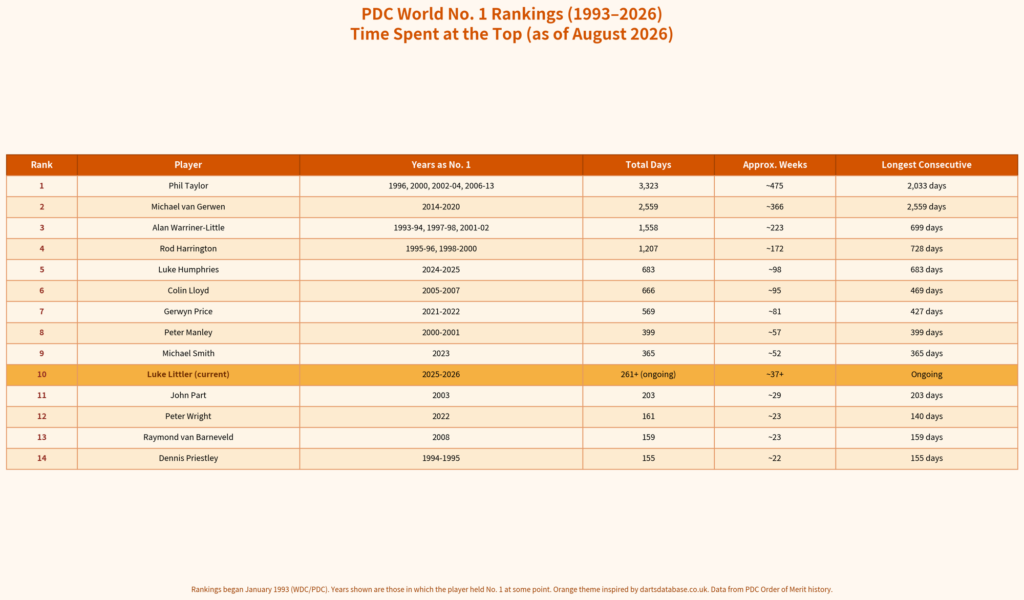
When people talk about PDC World Number Ones the conversation quickly jumps to Phil Taylor’s marathon spells of dominance or Michael van Gerwen’s unbroken 2,500-plus days. This was even the case in a ‘Number Ones’ piece at dartsworld.com last week. Yet, the first decade of the rankings tells a very different story.
Between the birth of the World Darts Council (WDC) in 1993 and the early 2000s the top spot changed hands among a small group of consistent, hard-travelling professionals who had peaks of major winning excellence and thrived under the old points system.
Alan Warriner-Little – the original Number One
Alan Warriner-Little (then still known simply as Alan Warriner) holds a unique place in the PDC history books. When the then WDC drew up its first ranking list at the start of 1993 he sat at the summit and stayed there for 674 days – almost two full years. He would return to the top on multiple further occasions, clocking up a total of around 1,550–1,560 days across five or six separate stints.
That still places him third on the all-time list, behind only Taylor and van Gerwen. Remarkably, during his long first reign he did not win a single PDC major. Consistency across the many non-televised ranking events of the time was enough. His one major title finally arrived later – the 2001 World Grand Prix – where he also posted a then-record double-start average of 106.45.
Nicknamed “The Iceman,” Warriner-Little was a founder member of the breakaway organisation and remains one of the most under-appreciated figures of the early PDC era.
DARTS IS A NUMBERS GAME: More Stats and Facts Pieces Here
Dennis Priestley – the first champion at the top
In November 1994 the ranking briefly shifted. Dennis Priestley, winner of the inaugural PDC World Championship earlier that year (and already a BDO world champion from 1991), took over after strong results and significant victories in major opens and TV events alike. His reign lasted 154–155 days until April 1995. Priestley was one of the true pioneers of the modern game and perhas the one damaged the most by ‘the split’. The Menance was a regular contender in the early World Championships and World Matchplay event, reaching several finals. His time at Number One was surprisingly short, but it underlined that major success could still translate into ranking position even under the points system.
Rod Harrington – the ranking machine
Rod Harrington, “The Prince of Style,” then enjoyed two substantial spells at the top. The first ran from April 1995 to August 1996 (around 478–479 days). The second, and longer, stretch began in August 1998 after he won the World Matchplay and lasted until July 2000 – 727–728 consecutive days. His career total of roughly 1,205–1,207 days which still has him fourth on the all-time list.
Harrington was the classic points-system player: a regular winner of ranking opens but one who could also shine on the biggest stages. Rod proved this with his dual World Matchplay championships (1998 and 1999). Those back-to-back titles at the Winter Gardens remain the highlight of his playing career. He also reached the World Championship final in 1995 and several other major semi-finals.
Like Warriner-Little he was a founder of the WDC/PDC and later served as a director and commentator. Harrington was a major influence in the creation of the tier structure and was a fierce advocate of the development of the game in this way.
DARTS PLAYER MERCHANDISE AND COLLECTABLES AT OUR DARTSWORLD STORE!
Peter Manley – the consistent traveller
Peter “One Dart” Manley claimed the top spot in September 2000 after the Windy City Open and held it for 398–399 days until October 2001. Manley’s sole major was the Las Vegas Desert Classic, yet his willingness to play almost every ranking event available kept him high in the points table for years.
Manley’s period as Number One is often cited as an example of how the old system rewarded volume and consistency over pure major dominance. But, it should also show, once and for all, that Peter was far more than the pantomime villain he is sometimes portrayed as.
These four players – Warriner-Little, Priestley, Harrington and Manley – between them accounted for the large majority of the Number One days from 1993 until the early 2000s.
The points-based system of the time placed heavy emphasis on the sheer number of events contested. There was no strict limit on how many ranking tournaments counted, so players who travelled constantly and posted solid results week after week could stay ahead of those who focused more narrowly on the big televised events. That landscape changed after the switch to a pure prize-money Order of Merit in 2007.
More on this subject – World Number Ones: Humphries Shines
Looking back, the early era produced a more fluid ranking and gave genuine recognition to a group of professionals who helped establish the PDC as a viable organisation. Warriner-Little’s multiple returns to the summit, Harrington’s long second reign, Priestley’s brief but symbolic spell, and Manley’s year-long stint all deserve more attention than they usually receive.
They were the first generation of PDC Number Ones – and for several years they defined what the ranking actually meant. Next time we shall look at two unique World Number ones.
Images: PDC Lawrence Lustig
Page / Graphic: DartsWorld Ltd